 Toni Maxx
Case study / One sign-in
IDUnify case study
IDUnify is single sign-on for a group of sites. It has an admin console for sites, teams and users, and a shared AI gateway where each person has their own credits. I designed and built it.

- Role
- Provider, console, account page, AI gateway
- Stack
- OpenID Connect, Firebase Auth, Node + TypeScript
- Product site
- idunify.com
My role
I designed and built the sign-in provider, the admin console, the account page and the AI gateway.
The problem
When one team runs several sites, each site tends to grow its own login. People then keep several passwords, and the team keeps several user lists. AI features add a second problem: each site pays for and limits its own AI use, and a person cannot see their total.
The approach
IDUnify uses OpenID Connect. A site registers as a client and sends people to one sign-in. Behind it is Firebase Auth. The person gets one account across the group.
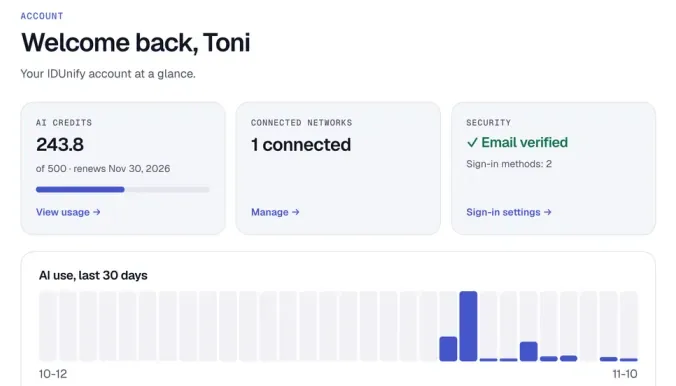
The admin console lets an owner manage sites, teams and users. An account page shows connected networks, a security overview and AI credits.
The AI gateway sits behind several of my products. A product that wants AI does not rebuild the plumbing. Credits belong to the person, not to the site, and the person sees where they were spent. AI can be wrong, and the products say so. See Sidekick Note and อปท.com for AI features that use it.
Stack
OpenID Connect, Firebase Auth and Node with TypeScript, as listed on the demo page.
Screens
What is public and what is not
Public: the idea, the stack, the account screen and the product site at idunify.com.
Not public: user lists, client secrets, keys, server details and the names of the sites in the group. I give no user counts. I make no security claims beyond the standard I use, OpenID Connect.
Related pages
Need one sign-in for your sites?
Tell me which sites and apps share users. I reply with a one-page recommendation and a written scope before any code.
Book the free consult